rogue

CLARE STEPHENS: 'The story of how I became a (very viral) meme.'

This article originally appeared on Clare Stephens' Substack, NQR.

For the last year or so, I've intermittently received messages from people I know, or from people who know of me through my work.

The messages are usually along the lines of, "Um, is this you?" followed by a link to a video. Sometimes it's a version of the video from Facebook, sometimes from Instagram, sometimes from TikTok. But the gist is the same:

Watch Clare's thoughts on becoming a meme on Mamamia Out Loud. Post continues below.


Video via Mamamia.

It starts with a photo of a rather unfortunate-looking child.

Glasses. Bad hair. Crooked teeth. The text below the photo reads: "to the guy who kept calling me four eyes in elementary."

Six year old Clare smiles at camera in school uniform, with glasses and a short bob. Image: Supplied.

ADVERTISEMENT

Moments later, it cuts to a selfie video of a voluptuous woman in lingerie, with the words, "Look at me now."

She's very attractive. She seems incredibly confident. She's also… very clearly not the girl in the childhood photo. Which is hilarious.

One particularly viral version of the video has been stitched by a man, who pops up at the end to ask if someone can "explain what the f*ck is going on here."

Woman poses pouting at camera.Image: TikTok/ @arieldeshae

ADVERTISEMENT

Again. Hilarious.

No matter how many times I'm sent this link, my reaction is always the same. I think it's really, really funny.

Which might be surprising, given that – whichever way you look at it – I'm the butt of the joke. I'm that little girl with the glasses, who's meant to be the 'before' in a (comedic) before and after.

Some of the people reaching out to me are checking that I'm okay. They're offering to report the video, or offering to reach out to the creator. But when I see that awkward child staring down the barrel of the camera, entirely oblivious that one day millions of people online will laugh at her silly little face, I don't feel hurt. In fact, I think I feel… liberated?

I'm six years old.

It's school photo day, and I'm wearing a uniform I'm yet to grow into.

ADVERTISEMENT

I have a fringe that appears to have been cut unevenly, as does the rest of my short hair, sitting just below my ears. One side of my hair is significantly thicker than the other, which adds to the general sense of crookedness in my appearance.

My glasses take up a large portion of my face, resting on a nose that also looks strikingly asymmetrical. I'm missing teeth, and the adult teeth that have come down aren't straight, resulting in a misalignment between my top and bottom jaw.

Despite it all, I seem genuinely happy. Smiling into the camera, unaware that the photographer must be thinking 'Dear God, there is no way to give this girl's parents a photo they'll want to display in their home'. I'm too young to know how important beauty is; the power it affords you, the way it makes life just a little easier.

When I stand up from that chair, from that photo, I imagine my attention turned immediately to the person I was always looking for when she wasn't directly beside me: my sister. I was lucky enough to have an identical twin who I'd never known life without, and whose face I instinctively adored, no matter how many teeth she was missing or how heinous her haircut was. Perhaps that helped. I knew that the value of a person went far beyond their physical features, that when you really love someone, their face becomes almost blurred – a feeling rather than an image.

My sister didn't have glasses (even identical twins aren't truly identical – environmental factors change gene expression, which is a story for another day), and at six, I was going through a particularly crooked phase, appearance-wise. But over the years we were both awkward in ways that were sometimes similar, and sometimes different. There was the eye patch phase (me), the bowl cut phase (both of us), the no front teeth phase (her), the bulky retainer phase (both of us), and the very-prominent-ears phase (her).

ADVERTISEMENT

By the end of primary school, and particularly at the beginning of high school, I had started to realise I wasn't beautiful. It made me angry, but more than that, it made me sad. It felt like the cruellest injustice. I could see how girls around me were rewarded for their piercing eyes and their flawless skin and their voluminous hair and their willowy but athletic bodies, and I wanted to scream that it wasn't fair because they hadn't done anything to deserve that admiration. They'd simply been born that way.

A lucky cluster of cells that gave them access to more confidence, more friends, more attention from the opposite sex. They seemed content in a way I never, ever was. In the later years of high school, I became determined to prove my worth in some external, verifiable way, so I turned my focus to being wildly academically competitive. I might not be beautiful, I told myself, but I could be smart.

I know now that even though I spent my teenage years deeply distressed by my body and my face, feeling like an outsider, a monster, I actually did – on paper – fit the sickeningly narrow 'ideal' of Western beauty standards.

I was an able-bodied, blonde, Caucasian, petite woman. In my early twenties, I sat opposite a male psychologist and when I expressed my anguish around my appearance, he was confused.

ADVERTISEMENT

"But you've got that, you know, little mousy look that men love," he said. I'm still not quite sure what he meant, and I think he missed the point, but now that I'm in my 30s, I understand that there are certain privileges afforded to me because of how I look. I think those biases are f*cked, obviously. But I'm not going to pretend they don't exist.

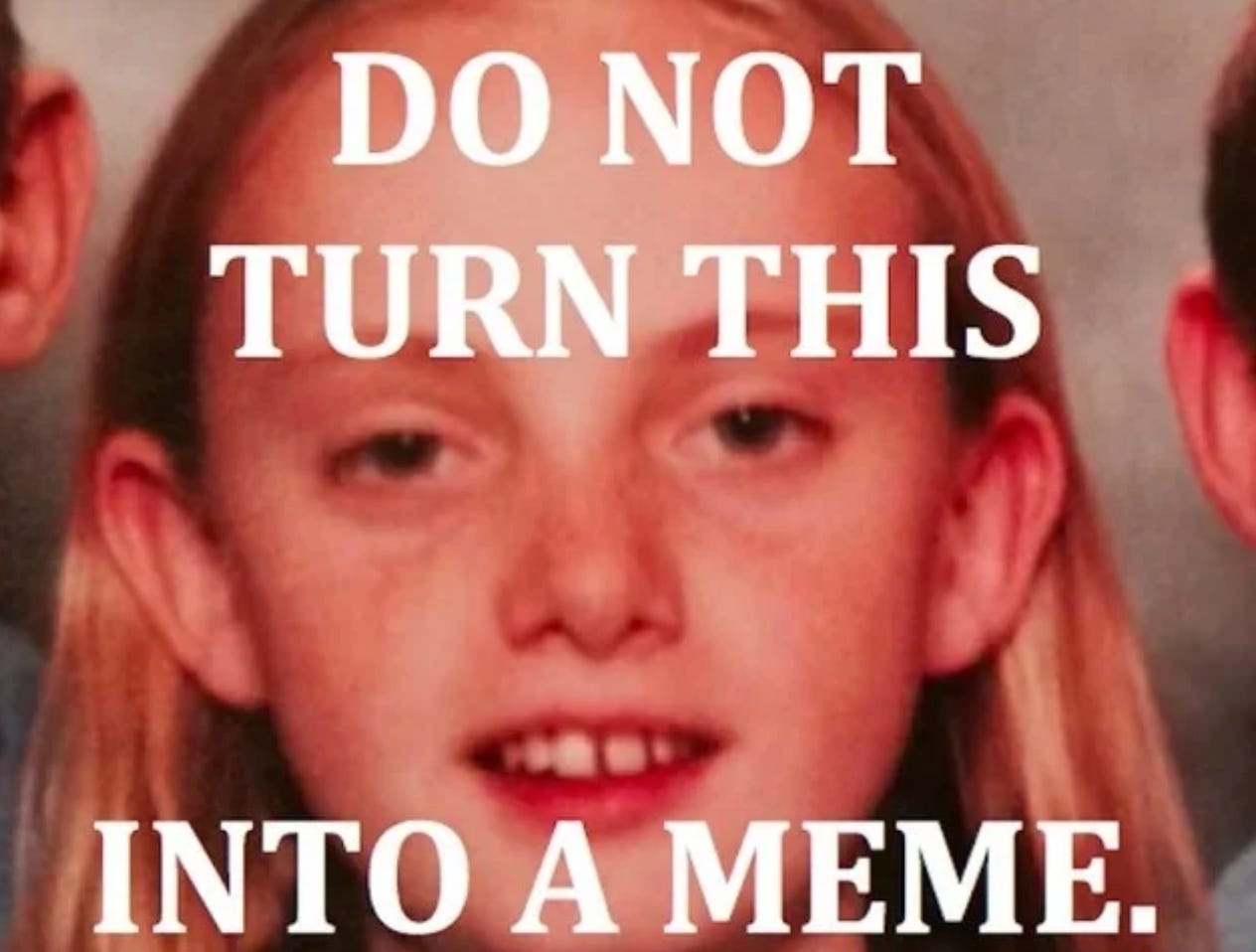
I'm not sure when my sister and I came to terms with the fact that we were, objectively, ugly children. Some people get angry and offended when we say that. In fact, we once wrote an article about it and were blown away by the backlash. (In said article, my sister was smart enough to explicitly ask the internet not to turn her into a meme. Perhaps I should've thought of that).

Jessie Stephens as a child with the text, 'DO NOT TURN THIS INTO A MEME.'Image: Substack/ NQR.

ADVERTISEMENT

In the comments, people insisted there was no such thing as an ugly child. All children are beautiful. And, yes, of course, all (good) parents find their kids cute. When they look at them, they see utter perfection, regardless of what the rest of the world sees.

I genuinely believe my almost two-year-old is the most gorgeous toddler who has ever existed on planet earth, and if someone tried to challenge that with some kind of technical analysis of her features, I'd tell them to get f*cked. She's a work of art. A miracle. Magic.

In hindsight, my sister and I both think we're actually very lucky we were ugly. (It's not that we think we're attractive now, but there is a definite improvement. I like to think I had Benjamin Button syndrome – I was born an old man and gradually grew into my skin.)

Baby Clare waves at the camera.Image: Substack/ NQR.

ADVERTISEMENT

The benefits are that when you're five years old with an eye patch, you learn very quickly that life isn't fair. You never have to deal with people only wanting to be friends with you because of how you look. You're routinely underestimated.

When you're beautiful, people laugh at your jokes when they're not that funny. How… confusing.

I was recently at an event with a group of friends, including one friend who is really, really, offensively beautiful. We all joked that sometimes we get distracted when she speaks because of how stunning her features are. The good news is: that never happens to me. No one is distracted by my physical appearance, except on the (frequent) occasions when I have food on my clothes or, relatedly, food on my face.

So, when I see photos of me as a child, I usually… burst out laughing.

My parents had two sets of twins, which meant at one point they had four kids under two and a half, and needless to say, buying us pretty outfits was not a priority.

ADVERTISEMENT

My Nan lived with us until she died when I was 14, and as a devout Catholic with an Irish background, she deplored nothing more than vanity. If we looked in the mirror too much, she was horrified.

I remember asking her when I was about 12 whether she thought I was beautiful, and she said, without hesitation, "You'll blossom."

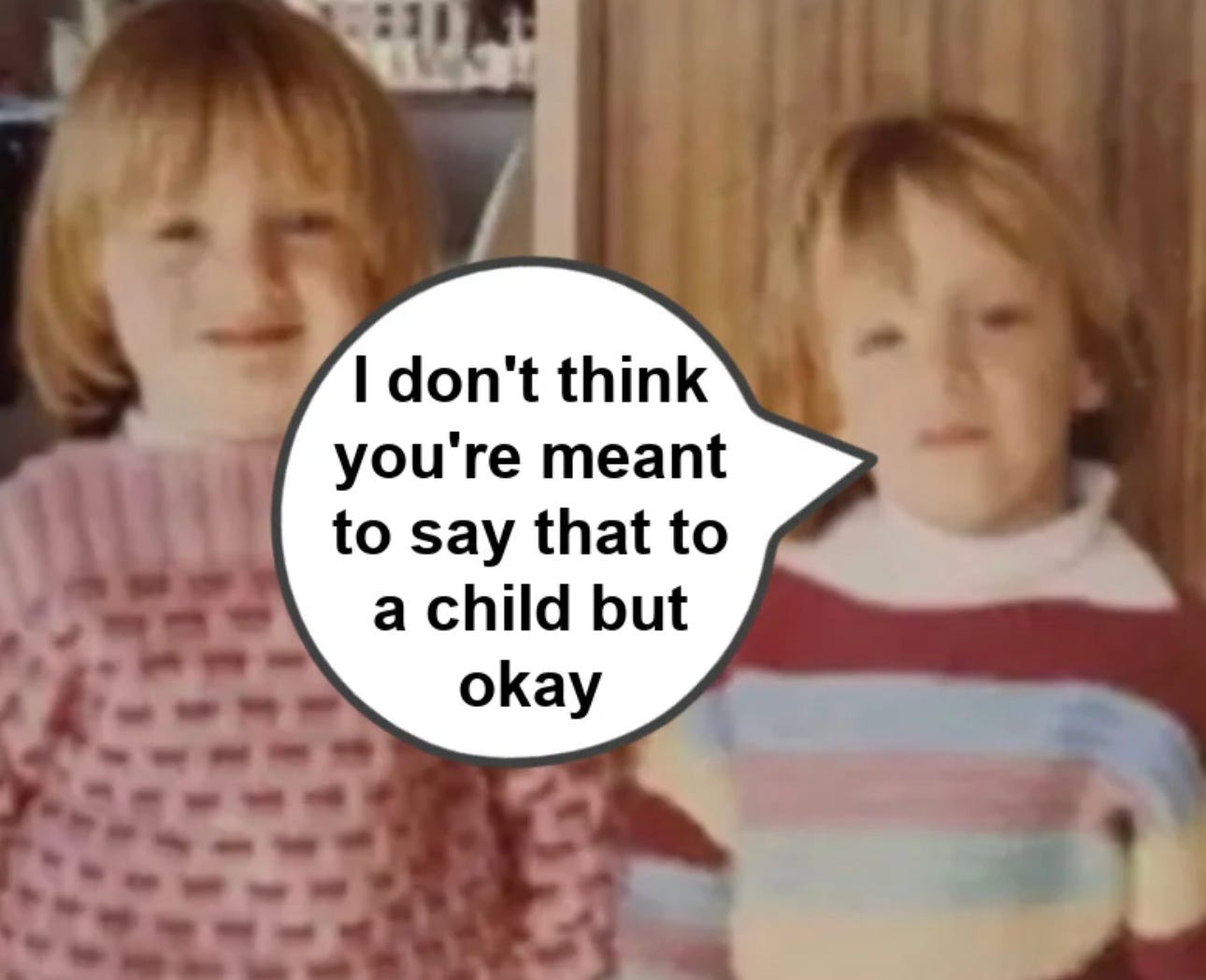
Jessie and Clare Stephens as children, with a speech bubble saying, 'I don't think you're meant to say that to a child but okay.'Image: Substack/ NQR.

Mum also didn't allow us to indulge in our physical appearance. She never did our hair for school (obviously. See: above photos). She never took us shopping for fashionable clothes. Even allowing us to get our ears pierced was a struggle.

ADVERTISEMENT

She hated the school formals, and we had lengthy fights begging for her to let us get our hair and makeup done. Eventually she did, but in the cheapest way possible.

I resented it at the time. I just wanted to be normal. I wanted to participate in the ceremony, the ritual of beauty, in the way other girls did. They got spray tans. They got their nails done. They had professional hair removal and went to fancy hairdressers. This wasn't a private school, by the way, it was a Catholic school with minimal fees, but anyone who's ever met a teenage girl is familiar with their frankly remarkable ability to get what they want.

Now, though, as an adult, I'm grateful for all the small ways my family refused to value beauty.

They refused to allow me to see it as a crucial part of my identity, to measure my self-worth against it. Sometimes I think I'll find the ageing process easier than other women because I don't feel that, physically, I'm losing anything I valued that much to begin with. I've never thought I was beautiful. So the idea of letting go of the 'beauty' of youth feels… fine.

I think that's why I laugh at that photo of me at six. It's not that I'm mocking her. It's not that I've erased her as a previous version of myself, or that I'm pretending she's a stranger – someone I don't recognise.

It's that I love her. I love that she was always reading, and secretly wanted to write a book one day but never, ever thought she would. I love that she was shy. She was curious. She was kind. I simply do not care about the way she looks.

ADVERTISEMENT

I don't mind people laughing at her glasses or her appalling haircut (no, but in all honesty, Mum, I don't know what the hell you were thinking).

Listen to the full episode of Mamamia Out Loud here. Post continues below.

I think one of the most liberating things a girl or a woman can do is separate her self-worth from her appearance. Maybe for a short while we do it in childhood, but once we become aware of ourselves, once our objectification becomes internalised, there's no way to go back.

I'm envious of that little four-eyed girl's naivety. The fact she didn't care how that photo would turn out.

I don't think I'll ever get back to that glorious freedom.

But I'm glad I had it for a moment. And that, 30 years on, I can at least see the tiny version of myself for what she was: a bit unfortunate-looking, but worth so much more than the pixels in a two-dimensional image.

Clare Stephens is the author of The Worst Thing I've Ever Done, you can buy here. Sign up to Clare Stephens' Substack, NQR.

Read more from Clare Stephens:

Feature image: Supplied.

00:00 / ???