celebrity

The quiet strategy (and secret weapon) behind the Beckham brand.

This article originally appeared on Aideen McDonald's Substack, Spin and Tonic. Sign up here.

With the Beckham family back in headlines after Brooklyn's very public (and detailed) statement, attention has once again shifted to how one of the most famous couples in the world handles fame, family and fallout in public.

I explored this exact scenario, where private family dynamics collide with a carefully built public brand, in a recent breakdown of Brand Beckham and the quiet strategies that have kept it resilient and relevant for nearly three decades.

***

I grew up in Ireland in the '90s in a Manchester United household with my favourite band — Spice Girls — permanently on the radio singing about Girl Power.

David Beckham was everywhere. Soccer pitches, tabloids, billboards, backstage at concerts. Very talented, extremely hot, gently goofy and attempting style (remember the headline-making sarong? Welcome to the nineties, people).
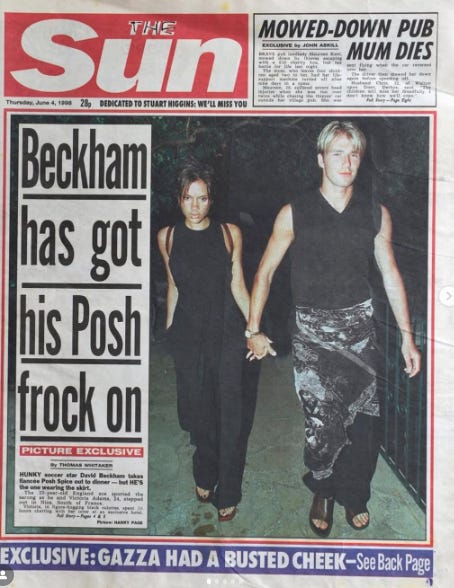
Image: Instagram/@90smilk and @uk_wired.

ADVERTISEMENT

Despite multiple scandals, Beckham has stayed broadly likeable and relevant across eras that have chewed up and spat out many celebs. That doesn't happen by accident.

And right now, he's back in focus. In the past 18 months alone, he's released a global Netflix documentary, become a garden and bee enthusiast, and casually been knighted by King Charles.

This isn't about whether Sir Beckham is "good" or "bad". It's about how he's survived being famous for this long, and what his approach to performance, restraint and timing (and a secret weapon) can teach anyone navigating reputational risk.

The World Cup red card: When a 'kick' became a national crisis.

The 1998 World Cup red card was a national trauma for England. In a knockout match against Argentina, with England's World Cup hopes on the line, 23-year-old David Beckham was sent off after flicking his leg at an Argentine player while lying on the ground. Simeone went down theatrically, the referee showed a red card, and England went on to lose the match on penalties.

ADVERTISEMENT

The blame of the loss landed squarely on Beckham, and the response from English fans was, quite frankly, deranged. He was hung out to dry by his coach (shame on you Glenn Hoddle), abused by fans, spat on in the street, and turned into a tabloid dartboard overnight (not kidding).

A David Beckham effigy was famously hung from a London pub, set alight and the photos plastered on national newspapers. One impulsive moment became a defining story of a young player's career.

What David did next.

Within hours of England's elimination, Beckham issued a written apology. Released the night of the match and carried across UK media the following morning, it took responsibility without qualification. He apologised to teammates, management and supporters. No justification. No explanation. Just a promise to do better.

"This is without doubt the worst moment of my career. I will always regret my actions during last night's game.

I have apologised to the England players and management and I want every England supporter to know how deeply sorry I am.

I only hope that I will have the opportunity in the future to be part of a successful England team in the European Championships and World Cup."

Then he stopped talking.

PR Lesson 1: Let your performance do the talking.

Beckham kept his head down and focused on his soccer. Back at his club Manchester United, he played a central role in the club's historic 1998–99 treble-winning season (This is a big deal. Think soccer's equivalent to an EGOT (Emmy, Grammy, Oscar, and Tony)).

ADVERTISEMENT

He was named FIFA World Player of the Year runner-up in 1999 and by the next World Cup, he was England captain, completing the full-circle moment by scoring the winning penalty against Argentina.

When your core product is strong, visible and sustained, performance becomes your most credible spokesperson. Show, don't tell.

Alleged affair with Rebecca Loos.

In June 2003, Beckham moved to Real Madrid, was at the height of his global fame, and was publicly positioned as a devoted husband and family man.

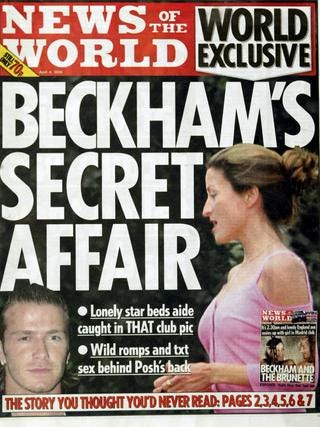
In April 2004, the now-defunct News of the World (the same News of the World accused of celeb phone-tapping) published photographs of Rebecca Loos claiming she had been having an affair with Beckham while working as his Personal Assistant in Madrid.

The story escalated quickly and what began as a single tabloid allegation widened into a rolling series of claims from multiple women, keeping the story alive across front pages and broadcast media.

Image: News of the World.

ADVERTISEMENT

Unlike the red card, this wasn't about a single moment under pressure. It was about his character and challenged the reputation he had built as a family man. His soccer skills couldn't answer this one.

What David did next.

Within days, Beckham issued a short written statement.

"During the past few months I have become accustomed to reading more and more ludicrous stories about my private life. What appeared this morning is just one further example.

The simple truth is that I am very happily married and have a wonderful wife and two very special kids. There is nothing any third party can do to change this."

ADVERTISEMENT

Classic containment language. Carefully worded. Non-specific. It doesn't name names or specifically deny the claims, it attempts to reaffirm his marriage and family, and to steer attention back to his public image.

Meanwhile, Rebecca Loos kept talking. She gave a televised interview, became a reality TV figure and Playboy covergirl and, as other women echoed similar claims, the story rolled on.

PR Lesson 2: Your statement is an invitation. Anticipate the (worst case) response.

Now, will we ever know if Beckham did in fact have an affair with Loos?

Officially, no.

But. If he didn't do it. A direct denial is the most obvious solution.

If he did, the choice is either own it, or deflect using legally accurate language.

Either way, the response you choose becomes the one you live with. Forever. You don't get a reset without causing more damage than the original story ever did.

("What about the third option?" I hear you ask. "To lie?" I never recommend this. Proof and the truth could come out at any time. Think Bill Clinton. Lance Armstrong. P-Diddy.)

The nuance often missed with legal deflection (as was missed here) is that the language still has to consider the human on the other end of it.

Good crisis communications asks more than "Is this legally accurate?" It asks: "What happens if we say this? Who's most likely to respond? And what will they do next?"

ADVERTISEMENT

Calling the story "ludicrous" doesn't just dismiss the claim. It dismisses the person making it.

Beckham's team couldn't have predicted how far this would go. But they should have known this: if someone believes their story is true and you publicly brush them off as a liar, they'll make it their life's work to be heard.

Bonus reputation (and life) tip: How you treat people, even on the way out, matters. In a world where almost everyone has access to a platform, making someone feel dismissed or humiliated can give them a reason to keep telling their version. Often for much longer.

Future-proofing the Beckham brand.

Sporting careers are short. The individuals who last beyond the pitch are the ones who start shaping a post-playing brand while still at their peak.

In January 2005, Beckham became a UNICEF Goodwill Ambassador. Over the next decade, football expanded from performance into purpose. From Let my football do the talking to Football for good.

ADVERTISEMENT

In 2015, he formalised that role with the launch of the 7 Fund, marking ten years with UNICEF. He has shone a light on the significant issues children, especially young girls, face around the world.

PR Lesson 3: Pick a purpose that fits your story.

The timing and theme of this partnership made total sense. Beckham didn't reach for purpose to help clean up a messy crisis or wait until his relevance dipped. He leaned into it while his football credibility was intact, his platform was global, and the story about him was already formed.

He also chose a lane that made sense. Football had always been his throughline. Framing it as a force for good was a smart expansion of his brand. Same story, wider scope.

An ambassadorship that questioned his values.

In 2022, Beckham signed a deal reportedly worth £150 million ($299 million AUD) as a Qatar ambassador ahead of the men's World Cup. He fronted glossy promotional campaigns praising the country and appeared in tourism videos sampling local art, food and culture.

ADVERTISEMENT

The reaction was swift. Critics pointed to Qatar's human rights record, treatment of migrant workers, and stance on LGBTQ+ rights. The backlash was led publicly by comedian Joe Lycett, who created a campaign calling on Beckham to step away from the role.

What David did next.

Beckham responded in two controlled ways. First, through a written statement issued via his representatives, later read out on Joe Lycett's TV show Got Your Back.

The statement said that David…

"has always believed that sport has the power to be a force for good in the world".

"We understand that there are different and strongly held views about engagement in the Middle East but see it as positive that debate about the key issues has been stimulated directly by the first World Cup being held in the region," the statement continued.

"We hope that these conversations will lead to greater understanding and empathy toward all people and that progress will be achieved."

Later, in short red-carpet interviews around the Netflix launch, Beckham stuck to the same framing. Calm. Rehearsed. No elaboration.

PR Lesson 4: Pressure-test partnerships against your values.

Once you've aligned yourself with certain values, every partnership needs to be held up against that record.

If a deal contradicts messaging you've been spouting for years, people will notice. And they'll happily quote you back to yourself, publicly.

ADVERTISEMENT

Ask the awkward questions early. Scenario planning and stress-testing the alignment before the announcement goes live. Beckham's long-standing work with UNICEF made the Qatar partnership feel more jarring, not less.

You need to make the decision whether the financial gain is worth the potential reputation damage.

PR Lesson 5: Don't try to win a values-based argument.

If you decide the financial upside is worth the potential reputational damage, you need to plan for fallout, not approval.

Values-based criticism doesn't respond well to debate. The harder you argue, the more entrenched people become. Beckham's instinct here was familiar by now: acknowledge the concern, widen the frame, and don't get dragged into specifics. And crucially, no naming the issue itself.

The goal isn't to change minds. It's to stop the issue from consuming everything else. That kind of restraint won't satisfy critics, but it does lower the temperature. And in values-led controversies that can be the difference between a brief (expected) flare-up and a months-long blaze.

Seems like the response to the 'ludicrous' Loos statement taught them a lesson.

Rumoured feud with son, Brooklyn.

Speculation about tension between David and Victoria Beckham and their eldest son Brooklyn has built gradually since Brooklyn's 2022 wedding to Nicola Peltz, then intensified through 2024 and 2025. Missed birthdays. Absent appearances. No public acknowledgements where there once were plenty.

ADVERTISEMENT

There was no single moment. Just patterns. And patterns are catnip for the internet sleuths.

What David did next.

He didn't do anything. At least not officially.

There's been no statement, no clarification, no attempt to correct the narrative. In interviews, it's the one topic they won't discuss.

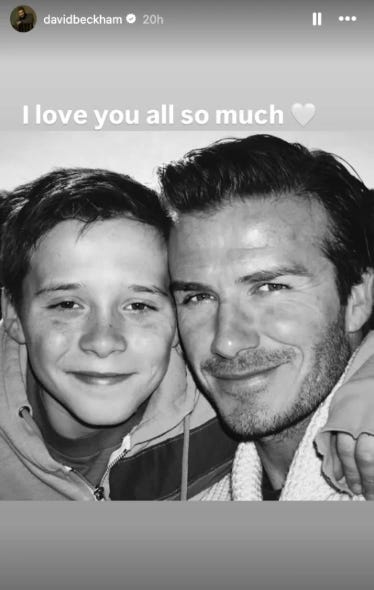
On social media, David and Victoria continue to talk about family broadly. Love. Pride. Support.

Even as speculation peaked, the approach hasn't change (so far). No naming. No explaining. No feeding the detail.

Image: Instagram/@davidbeckham

ADVERTISEMENT

PR Lesson 6: Not every story deserves your version.

When an issue affects the public, a response can be warranted. When it's family, it isn't. No one is owed an explanation of what's happening inside a private relationship, even when the people involved are famous.

There's also a quieter PR reality here. Beckham doesn't control the other voices in this story. Brooklyn and Nicola are adults with their own platforms. Say too much and you risk provoking a competing narrative you can't control. Say the wrong thing and you invite a tell-all from inside the family.

Silence here isn't avoidance. It's boundary-setting.

The Netflix test: did it help?

The Beckham documentary was a PR move. And it almost worked.

It reminded audiences just how much Beckham endured, it pulled David back into the cultural centre and, strengthened their reputation as a couple.

For Victoria, it was a quiet triumph, adding context, humour and humanity to years of caricature and showing the load she carried while supporting David and their family.

For David, though, it reopened old questions without resolving them, reignited Rebecca Loos' media frenzy, and cast a harsher light on career decisions that appeared to prioritise football over family. While it did a job repositioning him as a house and garden proud husband and father, it gave surprisingly little space to an easy win - his long-standing UNICEF commitment.

ADVERTISEMENT

In trying to tell everything, the documentary diluted the one thing Beckham has historically done best: restraint.

Beckham is most effective when he resists the urge to narrate. When he doesn't name the issue. When he leaves space rather than filling it. Over time, consistency and proof points have done the heavy lifting.

The most underrated asset in the Beckham brand…

Not that this article needed to be any longer, but I had a 'duhhh' moment as I was wrapping this up… Victoria Beckham has been David's secret weapon all along.

At the start of their relationship, her fame eclipsed his. The Spice Girls were a global phenomenon, and Victoria brought pop culture heat, fashion and mainstream attention to soccer. Much like Taylor Swift did for the NFL decades later, she made the game (and the players) interesting to people who didn't care about the score.

When David's reputation took hits, the red card, the tabloid years, the Loos allegations, Victoria stayed visible and supportive.

She also became the fallback villain. Distracting wife (from his focus on Man Utd and England). Absent wife (leading to his 'alleged' affair). The tabloid logic barely mattered. When blame was needed, she was an easy scapegoat.

Then she built something of her own. A global fashion business that stood apart from his fame and her prior career. It strengthened the Beckham brand even further.

ADVERTISEMENT

More recently, in her own documentary and her press around it, she has repeatedly called out David's belief in her and his constant support… And as anyone knows, being praised by someone else always lands harder than praising yourself.

The takeaway: say less, win more.

David Beckham hasn't survived three decades in the spotlight by winning arguments or rewriting history. He's survived by knowing when to speak, and when not to. Across his biggest moments, the instinct is consistent: acknowledge the moment, widen the frame, and don't feed the detail. He rarely names the thing he doesn't want to grow. Performance carries the message when it can.

What's often missed is that he hasn't done this alone. The Beckham brand has always been bigger than one man, strengthened by partnership.

If brands could take one lesson from Beckham? Know when to influence the game, and when to let it play out.

The Beckham story serves as a useful marker for what's to come as more parents turn their families into brands.

Reputation planning can't stop in the early years. It has to account for the moment children grow up, form their own identities and decide how much of the inherited story still fits.

Sign up to Aideen McDonald's Substack here.

Image: Getty.

Calling all Australians aged 18+!

We want to know about your favourite beverages! Complete our survey for a chance to win a $1,000 gift voucher in our quarterly draw!

Take survey →

00:00 / ???